
Custom Software vs Ready-Made Software: What Should a Pakistani Business Choose in 2026?
Custom or ready-made software? How Pakistani businesses can compare cost over time, fit, FBR invoicing, local payments and hybrid options before they choose.

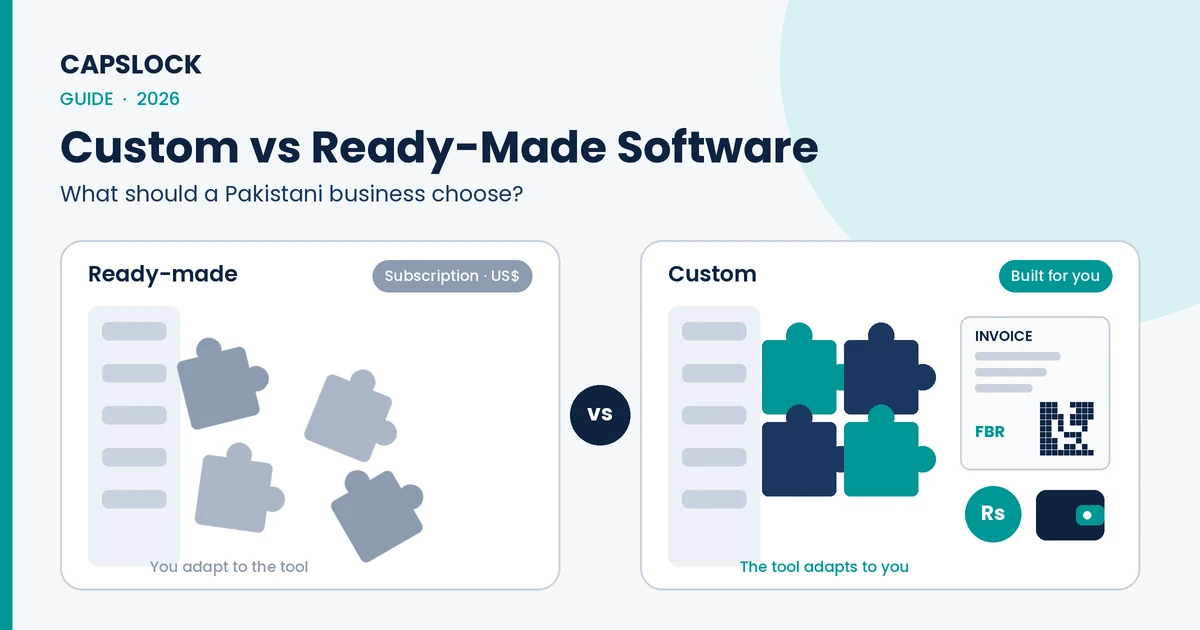
Short answer: when weighing custom software vs ready-made software, choose ready-made when a standard product already handles most of your work, you need to be live quickly, and you can live with the vendor’s limits. Choose custom software when your workflow is how you compete, when staff are retyping the same data across disconnected tools, or when you need integrations, local compliance or ownership that an off-the-shelf product will not give you. Plenty of Pakistani businesses do best with a hybrid: a ready-made core, with custom modules and integrations around it.
Below: what each option really costs over time, where each one wins, and the Pakistan-specific questions that change the answer, from FBR invoicing to JazzCash payments.
What we mean by custom and ready-made software
Ready-made software (also called off-the-shelf software or SaaS) is a product built once and sold to many businesses. Think accounting tools, ERPs, online-store platforms and POS systems that you sign up for, configure and start using. You usually pay a subscription or licence fee, and the vendor decides the roadmap.
Custom software is built for one business’s workflow. It might be a web application, a customer or partner portal, an internal operations tool, or a set of APIs that connect systems you already use. You fund the build, and if the contract is written properly you own the code, the database and the accounts.
The real question is which one fits this job, at this stage, for the next three to five years.
Custom vs ready-made software at a glance
| Factor | Ready-made (off-the-shelf / SaaS) | Custom software |
|---|---|---|
| Cost over time | Low upfront cost; recurring subscription that usually grows with users, plans and paid add-ons. Often billed in US dollars. | Higher upfront investment for the build; ongoing hosting and care costs, but no per-seat licence for your own system. |
| Fit | Built for the average business in a category. You adapt your process to the tool. | Built around how your business already works. The tool adapts to you. |
| Speed to launch | Fast: sign up, configure, import data and train. | Slower: discovery, design, development and testing come first. A focused first release takes weeks, not days. |
| Scalability | Scales well inside the product’s design; can become expensive or restrictive at the edges. | Scales in the direction you need, provided it is architected and hosted properly. |
| Ownership | You rent access. Data export, pricing and features are the vendor’s call. | You own the code and data (check the contract). No lock-in to one vendor’s roadmap. |
| Integration | Limited to the vendor’s built-in connectors, apps and API. | Integrations are designed for your stack, including local gateways and FBR requirements. |
| Support | Vendor support, often ticket-based and in other time zones; local partners vary. | Support from the team that built it, under a care agreement you negotiate. |
When ready-made software wins (and it often does)
We build custom software for a living, and we still often tell clients to buy off the shelf. Ready-made is usually right when:
- The job is standard. General accounting, email, HR records and simple online stores have been solved well many times. If a product already covers most of what you need, paying to rebuild it rarely makes sense.
- Speed matters more than a unique workflow. A new store or a start-up testing demand should launch in days, learn, and invest later.
- Your budget favours configuration over a new build. A subscription keeps upfront risk low.
- You can accept the vendor’s limits. If your team can work the way the product works, you get years of vendor-funded improvements for a monthly fee.
A good example is e-commerce. A small brand selling a modest catalogue online can often launch on Shopify or WooCommerce without a line of custom code. Our website cost guide covers those platform fees and what they include.
Be clear about the trade-offs, though. Ready-made products charge you for every extra user, plan upgrade and paid app, and many are priced in US dollars. On 19 November 2026, Shopify’s Pakistan pricing page listed its Basic plan at US$25 a month, or US$19 a month billed yearly, with higher plans costing more. Odoo’s pricing page offers one app free and charges its all-apps plans per user, per month. Fair models, but your rupee bill moves with the exchange rate and your headcount.
When custom software wins
Custom software earns its cost when the problem is specific to how your business works. The clearest signals are:
- Staff retype the same data in several places. Orders in WhatsApp, stock in Excel, invoices in an accounting tool and approvals over the phone. Every copy is a chance for error.
- Your workflow is your advantage. If the way you quote, schedule, dispatch or price is part of why customers choose you, forcing it into a generic tool can blunt the very thing that makes you different.
- You need one system across sales, operations and accounts. Several separate subscriptions that do not talk to each other often end up costing more, in fees and in staff time, than one connected system.
- Off-the-shelf tools need painful workarounds. Missing modules, rigid approval flows, reports you rebuild by hand every month: these are signs you have outgrown the product.
- Ownership and data matter. If the system will hold your core records for years, owning the code and choosing where the data is hosted can be worth more than the convenience of renting.
Our own products started from exactly this kind of gap. FrontDesk is cloud hotel management software for independent hotels, guest houses and hotel groups, bringing reservations, room status, billing, inventory, payroll, accounts and the night audit into one system. TheFoodPOS is restaurant POS software for cafés, fast-food businesses and restaurants to manage orders, tables, billing and reporting. Running products like these is why we treat maintenance as seriously as launch day. You can see both on our products page.
The Pakistan factor: questions that change the answer
Most custom vs off-the-shelf comparisons are written for the US or Europe. A Pakistani business has extra questions to ask.
1. FBR invoicing and POS integration. FBR requires sales tax registered persons to integrate their POS, ERP or invoicing system with its computerised system through a licensed integrator or PRAL, and to issue electronic invoices. S.R.O. 1852(I)/2025 set the phased timetable for that, and the last of its deadlines was 31 December 2025. Tier-1 retailers have separate rules for integrating every point of sale with FBR for real-time sales reporting. Before you buy any ready-made POS or ERP, ask whether it supports FBR integration for your category, and who handles the integration. Requirements also differ by tax and province, so confirm the details with your tax adviser.
2. Local payments. Many Pakistani customers pay through JazzCash, Easypaisa, bank transfer or cash on delivery. Global products may not support these out of the box, so check what the vendor actually offers before you assume you can collect payments in rupees. A custom build, or a custom integration, can connect to the gateways your customers use.
3. Currency risk. A subscription priced in dollars is fixed in dollars, not in rupees. If the rupee weakens, your software bill rises even though nothing else changed. With custom software, the build is paid once in a currency you agree; hosting and support costs remain, but you are not paying a per-seat licence for your own system.
4. Language and local workflows. Urdu interfaces or receipts, local address formats, and approval chains that run through a manager’s WhatsApp are easy to design into custom software and hard to force into a product built for another market.
5. Connectivity and hosting. Internet and power interruptions are a real operating condition for many businesses. Ask how each option behaves when the connection drops: can staff keep billing and sync later, or does the counter stop? Also ask where your data is hosted and who can access it.
6. Support in your hours. When billing stops on a busy evening, a ticket queue in another time zone does not help. Ask who answers, when, and in which language.
The hybrid option: customise or extend ready-made software
You do not always have to choose one or the other. Many of the best systems we see are hybrids:
- A ready-made core with custom modules. Keep a proven accounting tool or online-store platform, and build the one module it lacks, such as a custom quoting tool, a dealer portal or a dispatch screen.
- Custom integrations between tools you already trust. Connect your store, accounting, CRM, WhatsApp, SMS and payment gateways so data moves automatically instead of being copied by hand.
- Automation on top. Many repetitive steps, such as follow-ups, report generation, data entry from documents and lead routing, can be handled with workflow and AI automation without replacing anything.
- A companion app. If customers or field staff need a phone app on top of a system you already run, a focused mobile app can sit on your existing data.
A hybrid keeps what already works, spends budget only where the gap is real, and is a lower-risk way to test whether full custom software is worth it later.
A simple decision checklist
Answer these honestly. The more “yes” answers you have in the second list, the stronger the case for custom software or a hybrid.
Ready-made is probably enough if:
- A standard product already covers most of the job well.
- You need to be live within days or a few weeks.
- Your team can work the way the product works.
- The product supports your payment methods and FBR requirements.
- The total subscription cost for your expected users over three years is acceptable, even if the rupee moves.
Consider custom or hybrid if:
- Staff copy the same data between two or more tools every day.
- Your workflow, pricing or service model is part of how you compete.
- You have tried ready-made tools and keep hitting workarounds or missing modules.
- You need integrations, local payments, Urdu or compliance features the products do not offer.
- Owning the code, data and hosting matters for the next five years.
- Per-user fees are growing faster than the value you get from the tool.
If you land in the middle, start with the smallest custom piece that removes the biggest pain, and keep the rest ready-made. When you compare teams to build it, our guide to choosing a software development agency in Pakistan covers what to ask.
Frequently asked questions
Is custom software better than off-the-shelf software?
Neither is better in general. Off-the-shelf suits standard jobs where speed and low upfront cost matter. Custom suits specific workflows, deep integrations, local compliance and ownership. Many businesses use both.
Is custom software more expensive than ready-made software?
It costs more upfront because you pay for the build. Over several years the comparison depends on how many users you have, which plans and add-ons you need, and whether the subscription is priced in dollars. Compare the total cost over three to five years, not just the first invoice.
How long does it take to build custom software?
It depends on scope. A focused first release covering the core workflow often takes about 8 to 16 weeks once discovery, access and designs are ready. Larger systems, heavy data migrations or many integrations take longer.
Can ready-made software be customised instead?
Often, yes. Many products allow configuration, plug-ins, apps or API access. A hybrid approach keeps a proven core and adds custom modules or integrations only where the product falls short.
Does my business software need to integrate with FBR?
If you are a sales tax registered person, FBR rules require your POS, ERP or invoicing system to be integrated with its system through a licensed integrator or PRAL for electronic invoicing, and tier-1 retailers have their own POS integration rules. Check with your tax adviser which rules apply to you, and confirm that any software you choose supports them.
Will I own custom software?
You should. Make sure the contract states that you own the source code, the database and the accounts, and that the code is kept in a repository you can access. At CapsLock, code, data and accounts for the software we build for you are yours.
Not sure which route fits? Start with the workflow
If you are weighing a ready-made tool against a custom build, describe the problem rather than picking a technology first. Tell us which tasks take too long, which tools you already use, and what has to connect. We will tell you honestly whether an existing product, a hybrid or custom software development is the right fit, including when you do not need us.
Contact us to talk through your workflow. CapsLock has been building software from Lahore since 2016.
Let’s build what your business needs next.
Share your idea or challenge. We reply within one business day with clear next steps.